
• Skip to primary navigation
  • Skip to main content
DB-I Logo

DenseBreast-info, Inc.

Get Smart About Being Dense

HOME/USA

EUROPE

Español

  • Home
  • For Patients
    • Patients Home
    • Dense Breasts: 5 Facts You Should Know
    • Is My Mammogram Enough?
    • Screening Tests After a Mammogram (Table)
    • Let’s Talk About Dense Breasts, Video Series
    • Patient Questions and Answers
    • Patient Resources by Language
    • Print: Patient Fact Sheet
    • Print: Patient Brochure
  • For Providers
    • Providers Home
    • CME/CE: “Dense Breasts, Risk, and Supplemental Screening”
    • Flow Chart: Who Needs More Screening?
    • Health Care Provider FAQs
    • Risk Model Tutorial
    • Table: Mammography Guideline Comparison
    • Table: Dense Breast Screening Guidelines
    • Table: High/Increased-Risk Screening Guidelines
    • DBI Research
    • Patient Resources
  • Screening Technologies
    • Screening Technologies Home
    • For Patients: Screening Tests After a Mammogram (Table)
    • For Providers: Cancer Detection by Screening Method (Table)
    • 2D/3D Mammography
    • Mammography AI Screening Tools, Comparative Tables
    • Breast Ultrasound (Sonogram)
    • Breast MRI
    • Contrast-Enhanced Mammography (CEM)
    • Molecular Breast Imaging
    • DBI Research
  • Inform/Insurance Laws
    • Inform/Insurance Laws Home
    • Inform: Federal FDA Dense Breast Reporting
    • Insurance
      • State Law Insurance Map and Federal HRSA Guidelines
      • State Law Insurance Table
      • Federal Insurance Bill: Find It Early Act
  • Blog & Press
  • About Us
    • About Us Home
    • Our Mission
    • World Dense Breast Day
    • Our Team
    • DBI Research
    • Let’s Talk About Dense Breasts, Video Series
    • Patient Resources
    • Contact Us
    • Please Donate
  • Our Corporate and Health Group Supporters
/ For Providers / High/Increased-Risk Screening Guidelines

High/Increased-Risk Screening Guidelines

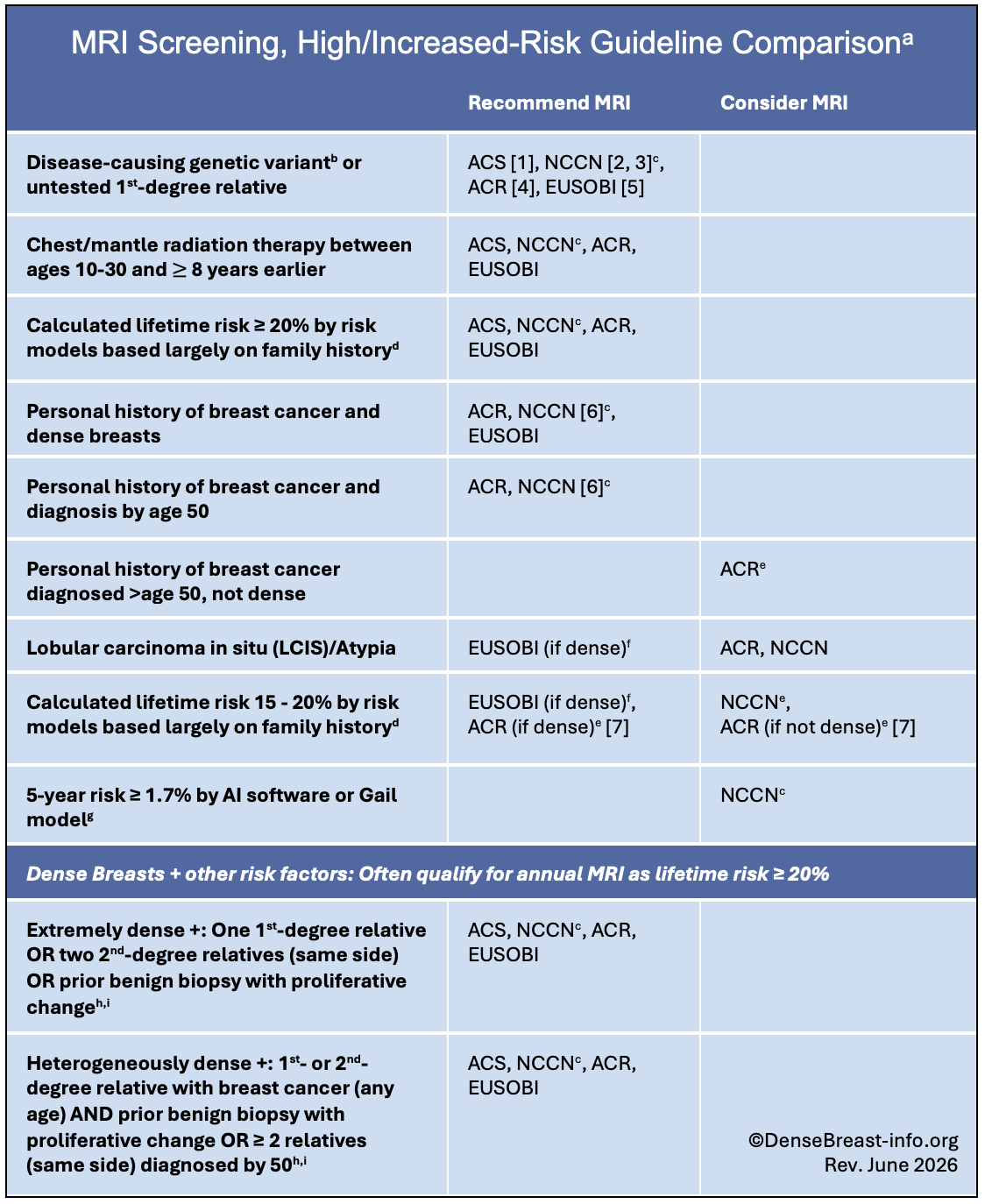
High or increased risk criteria for purposes of recommending MRI screening differ by organization and are provided in the table below. For screening guidelines for women with dense breasts and no other identifiable risk factors, see Dense Breast Screening Guidelines.

Abbreviations used: ACR American College of Radiology; ACS American Cancer Society; NCCN National Comprehensive Cancer Network; EUSOBI European Society of Breast Imaging

a Frequency of MRI screening is annual unless otherwise specified.
b For specific recommendations for age to start and stop screening MRI and include mammography, see https://densebreast-info.org/providers-faqs/what-is-the-screening-management-for-various-other-mutation-carriers/.
c For individuals at high risk who are not able to undergo MRI, supplemental screening with CEM or MBI should be considered.  Whole breast ultrasound may be done if contrast-enhanced imaging or functional imaging is not available.
d For more about risk models, see https://densebreast-info.org/for-providers/risk-model-tutorial/.
e Frequency of MRI screening is not specified.
f EUSOBI recommends MRI in women with extremely dense breasts from ages 50-70 at least every 4 years (preferably every 2-3 years). Frequency is not specified for women with heterogeneously dense breasts.
g 5-year risk increases with increasing patient age and, on average, 3.1% 5-year risk is approximately similar to a 20% lifetime risk [8]. Nearly all women have a 5-year Gail model risk of > 1.7% over the age of 58, regardless of breast density, and such a threshold is therefore its use to guide MRI screening is deemed inappropriate by the DenseBreast-info.org medical advisory board.
h Lifetime risk ≥ 20% when entered into Tyrer-Cuzick risk model at https://magview.com/ibis-risk-calculator/ with otherwise average risk factors.
i Proliferative change would be listed in the pathology report from the breast biopsy as any of the following: usual ductal hyperplasia, papilloma, adenosis or sclerosing adenosis, radial scar.
For evidence-based screening recommendations in any risk category designed to optimize cancer detection, see our Screening Decision Support Tool. It details:

  • The American College of Radiology (ACR[4]) recommends all women, but especially Black women and women of Ashkenazi Jewish descent, undergo risk assessment and possible genetic testing by age 25.
  • Those at higher risk can begin earlier and more aggressive breast cancer screening, as early as age 25.
  • All women should start screening at least by age 40.
  • Supplemental screening beyond mammography is not generally recommended beyond age 75. At that time, decisions about appropriate screening should be made on an individual basis depending on a woman’s overall health and risk factors.

Considerations

  • If MRI screening is recommended but is not available or possible, contrast-enhanced mammography (CEM) [3, 4] or molecular breast imaging (MBI) should be considered [3]. When no contrast-enhanced methods are available, screening ultrasound can be considered [3, 4].
    • Per ACR, MBI is “usually not appropriate” for screening due to whole body radiation exposure [4, 7].
    • CEM is currently only FDA-approved for diagnostic breast imaging in the United States and has limited availability.
  • Any screening test can identify abnormalities that require additional testing for findings that are not cancer (false alarms, or “false positives”). False positives are most common the first time a test is used and decrease when prior comparison examinations are available.

References Cited

1. Saslow D, Boetes C, Burke W, et al; American Cancer Society Breast Cancer Advisory Group. American Cancer Society guidelines for breast screening with MRI as an adjunct to mammography. CA Cancer J Clin 2007;57(2):75–89.

2. National Comprehensive Cancer Network. NCCN Clinical Practice Guidelines in Oncology (NCCN Guidelines). Genetic/ familial high-risk assessment: breast, ovarian, pancreatic, prostate. v.3.2026—February 19, 2026. Available at: https://www.nccn.org/professionals/physician_gls/pdf/genetics_bopp.pdf

3. National Comprehensive Cancer Network. NCCN Clinical Practice Guidelines in Oncology (NCCN Guidelines). Breast cancer screening and diagnosis v.1.2026 – March 5, 2026. Available at https://www.nccn.org/professionals/physician_gls/pdf/breast-screening.pdf

4. Monticciolo DL, Newell MS, Moy L, Lee CS, Destounis SV. Breast Cancer Screening for Women at Higher-Than-Average Risk: Updated Recommendations From the ACR. J Am Coll Radiol. 2023 Sep;20(9):902-914

5. Marcon M, Fuchsjäger MH, Clauser P, Mann RM. ESR Essentials: screening for breast cancer – general recommendations by EUSOBI. Eur Radiol. 2024 Oct;34(10):6348-6357.

6. National Comprehensive Cancer Network. NCCN Clinical Practice Guidelines in Oncology (NCCN Guidelines). Breast Cancer. v.4.2025—April 17, 2025. Available at: https://www.nccn.org/professionals/physician_gls/pdf/breast.pdf

7. Paulis LV, Lewin AA, Weinstein SP, et al. ACR Appropriateness Criteria Supplemental Breast Cancer Screening Based on Breast Density. Available at https://acsearch.acr.org/docs/3158166/Narrative?_gl=1*1xyap41*_ga*MTY1OTgyNzAxOS4xNzM0NDU1Mzk4*_ga_K9XZBF7MXP*MTczNDQ1NzIxMy4xLjEuMTczNDQ1NzIxMy4wLjAuMA. American College of Radiology. Accessed December 17, 2024.

8. Colditz GA, Bennett DL, Visvanathan K, Rosner BA, Jiang S. A Framework for Aligning 5-Year and Lifetime Breast Cancer Risk in Women Without High-Penetrance Mutations. J Breast Imaging. 2026, epub 4/26/2026.

DenseBreast‑info, Inc. is an independent, nonprofit organization. DBI is not affiliated with or endorsed by other organizations unless expressly identified. If you have questions about DBI’s programs or partnerships, please contact us.

© Unpublished, DenseBreast-info, Inc. ALL RIGHTS RESERVED | 501(c)(3) Public Charity

  • Online Privacy Policy
  • Online Terms of Use & Disclaimers

This website is for informational purposes only and is not intended to be a substitute for medical advice from a physician or to create a standard of care for health care providers. In addition, information has been provided by independent third parties and may not represent the views of DenseBreast-info.org. Please check with a physician regarding your specific condition, if you have any questions, or need a diagnosis. If you are experiencing an urgent medical condition, call your local emergency services [e.g., 9-1-1 (in the USA) or 1-1-2 (in Europe)].