• Skip to primary navigation
  • Skip to main content
DB-I Logo

DenseBreast-info, Inc.

Get Smart About Being Dense

HOME/USA

EUROPE

Español

  • Home
  • For Patients
    • Patients Home
    • Dense Breasts: 5 Facts You Should Know
    • Is My Mammogram Enough?
    • Screening Tests After a Mammogram (Table)
    • Let’s Talk About Dense Breasts, Video Series
    • Patient Questions and Answers
    • Patient Resources by Language
    • Print: Patient Fact Sheet
    • Print: Patient Brochure
  • For Providers
    • Providers Home
    • CME/CE: “Dense Breasts, Risk, and Supplemental Screening”
    • Flow Chart: Who Needs More Screening?
    • Health Care Provider FAQs
    • Risk Model Tutorial
    • Table: Mammography Guideline Comparison
    • Table: Dense Breast Screening Guidelines
    • Table: High/Increased-Risk Screening Guidelines
    • DBI Research
    • Patient Resources
  • Screening Technologies
    • Screening Technologies Home
    • For Patients: Screening Tests After a Mammogram (Table)
    • For Providers: Cancer Detection by Screening Method (Table)
    • 2D/3D Mammography
    • Mammography AI Screening Tools, Comparative Tables
    • Breast Ultrasound (Sonogram)
    • Breast MRI
    • Contrast-Enhanced Mammography (CEM)
    • Molecular Breast Imaging
    • DBI Research
  • Inform/Insurance Laws
    • Inform/Insurance Laws Home
    • Inform: Federal FDA Dense Breast Reporting
    • Insurance
      • State Law Insurance Map and Federal HRSA Guidelines
      • State Law Insurance Table
      • Federal Insurance Bill: Find It Early Act
  • Blog & Press
  • About Us
    • About Us Home
    • Our Mission
    • World Dense Breast Day
    • Our Team
    • DBI Research
    • Let’s Talk About Dense Breasts, Video Series
    • Patient Resources
    • Contact Us
    • Please Donate
  • Our Corporate and Health Group Supporters
/ For Patients / Screening Tests After a Mammogram

Screening Tests After a Mammogram

Mammograms are the first step in screening for all women. However, in women with dense breasts, there are cancers that will not show on a mammogram. Additional tests after a mammogram may find these cancers. Importantly, women should not skip their mammogram, as some cancers are only seen on a mammogram, even in dense breasts.
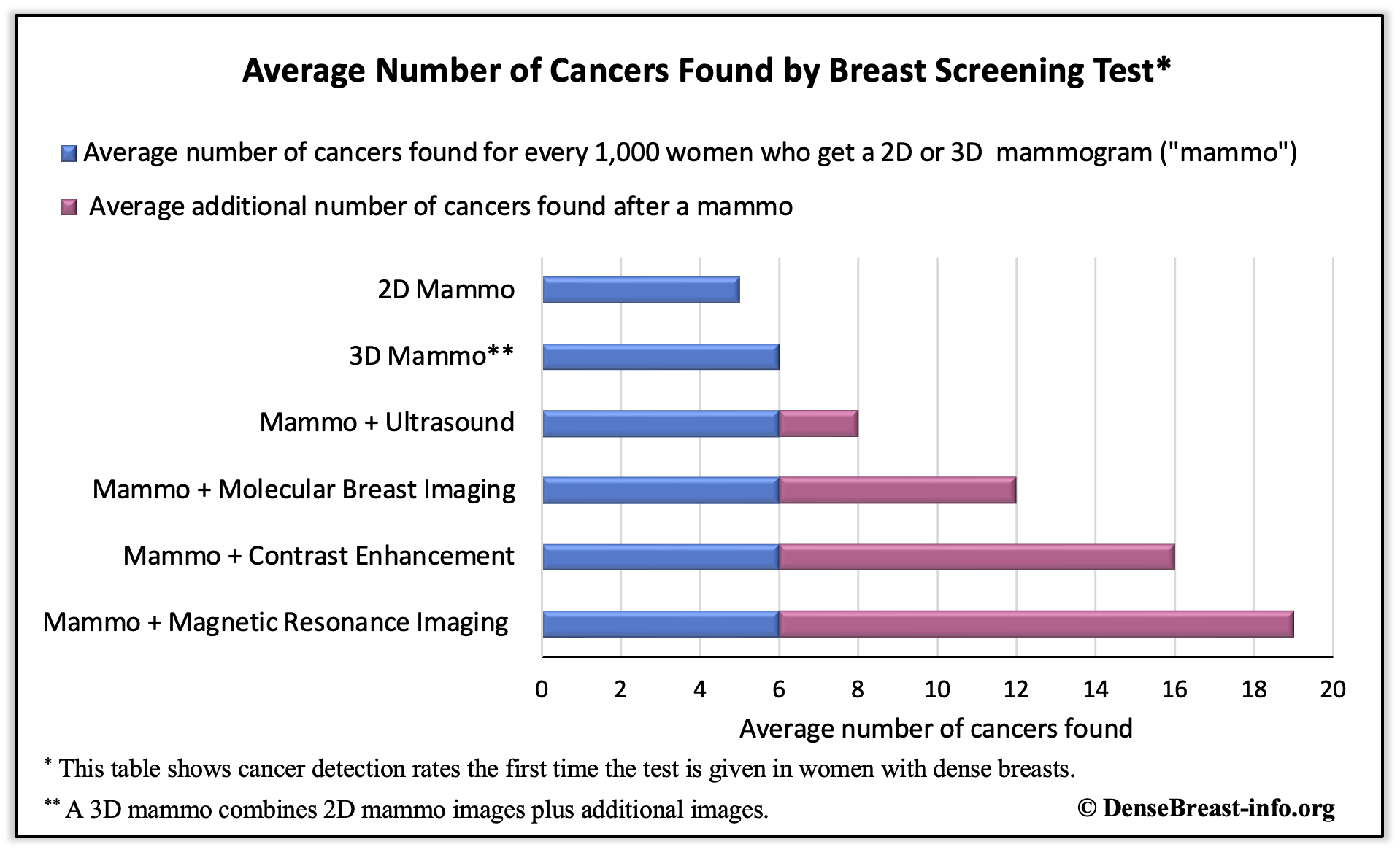
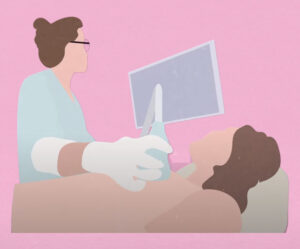
table showing number of cancers found per screening test

When making a choice about an additional screening test after a mammogram, there are things to consider. For instance, additional screening tests may find things that need even further testing that turn out not to be cancer (known as a false positive). Discuss with your health professional what might be right for you.

The tests listed below are not affected by breast density and can find cancers that will not show on a mammogram (either 2D or 3D).

  • Ultrasound (US)
  • Molecular Breast Imaging (MBI)
  • Contrast-Enhanced Mammogram (CEM)
  • Magnetic Resonance Imaging (MRI)
×

Ultrasound

Ultrasound (US)

Ultrasound is the most widely available additional test used after a mammogram. Ultrasound uses sound waves to create images of your breasts. It does not involve radiation or an injection. Gentle pressure is applied to the breasts with a wand (known as a transducer), a plate-like frame, or by lying face down on a table and lowering each breast into an opening. Ultrasound rarely causes discomfort and screening takes about 15 to 20 minutes.

  • Ultrasound is most often performed on a small area of the breast (known as a “limited” ultrasound).
  • A “limited” ultrasound is performed due to symptoms (like a lump), or other finding on a mammogram.
  • A “screening” ultrasound (when no symptoms are present) of the whole breast(s) is sometimes performed in women with dense breasts.
  • Screening ultrasound can be used when MRI is recommended but cannot be performed.
×

MBI

Molecular Breast Imaging (MBI)

Molecular breast imaging  involves injection of a radioactive material into your vein. About 5 minutes after the injection, your breast is placed between two detectors similar to a mammogram but with less pressure. An MBI test takes at least 40 minutes. MBI is not yet widely available.

  • MBI results in radiation exposure to the full body (totaling about 4 times the amount of radiation as from a mammogram, but still considered small and within acceptable limits).
  • MBI can be used to look at areas of concern seen on a mammogram or breast ultrasound.
  • For women with dense breasts, some breast centers also use MBI for additional screening (when no symptoms are present) after a mammogram.
  • Where available, MBI is an option when MRI cannot be performed.
×

CEM

Contrast-Enhanced Mammogram (CEM)

Contrast-enhanced mammogram (CEM) is a specialized mammogram that uses injection of an iodine dye into a vein. About 2 minutes after the injection, you will have a mammogram and two sets of images will be taken of each breast. One set is like a standard 2D mammogram, and the second set (with the dye) helps show cancers. CEM uses about twice as much radiation as a standard mammogram (but still low and safe amounts) and takes about 10 minutes. CEM is a newer technology that is becoming more widely available.

  • The iodine dye is the same dye used in CT scans (be sure your health team knows if you have had a bad reaction to CT scan dye).
  • CEM is being studied for breast cancer screening (when no symptoms are present), especially in women with dense breasts.
  • CEM finds cancers at a rate similar to that of an MRI.
  • Where available, CEM is an option when MRI cannot be performed.
×

MRI

Magnetic Resonance Imaging (MRI)

Contrast-enhanced Magnetic Resonance Imaging involves injection of a non-radioactive solution (gadolinium contrast) into your vein. The exam is done in the tunnel of a large magnet. You lie on your stomach and your breasts fit into two openings. The machine makes loud noises while generating images.  MRI takes about 25 minutes (or 10 minutes for an “abbreviated” MRI, though abbreviated MRI is not offered at all imaging centers).

  • MRI finds more cancers than any other screening test.
  • For women at high risk for breast cancer aged 25-29, yearly MRI screening alone is recommended. If at high risk after age 30, both mammography and MRI are recommended every year. (For European guidelines by country, see DenseBreast-info/Europe).
  • For women who have dense breasts and no other risk factors who seek additional screening, MRI should be considered starting at age 40 (if available).
  • Women who are claustrophobic may want to discuss with their health professional whether it might help to take a sedative (a medication to reduce anxiety) before the examination.
Is My Mammogram Enough? How Do I Know If I Am High Risk?

DenseBreast‑info, Inc. is an independent, nonprofit organization. DBI is not affiliated with or endorsed by other organizations unless expressly identified. If you have questions about DBI’s programs or partnerships, please contact us.

© Unpublished, DenseBreast-info, Inc. ALL RIGHTS RESERVED | 501(c)(3) Public Charity

  • Online Privacy Policy
  • Online Terms of Use & Disclaimers

This website is for informational purposes only and is not intended to be a substitute for medical advice from a physician or to create a standard of care for health care providers. In addition, information has been provided by independent third parties and may not represent the views of DenseBreast-info.org. Please check with a physician regarding your specific condition, if you have any questions, or need a diagnosis. If you are experiencing an urgent medical condition, call your local emergency services [e.g., 9-1-1 (in the USA) or 1-1-2 (in Europe)].