Is My Mammogram Enough?

Know
- Dense breasts can hide cancers on a mammogram and also increase the risk of breast cancer.
- Almost half of women have dense breasts. Learn about five important facts to know.
- If you have dense breasts, find out whether they are “heterogeneously dense” or “extremely dense.” Check your patient portal, or ask your mammography center or healthcare professional.
Do
- If available, get a 3D mammogram (also called digital breast tomosynthesis) instead of a 2D mammogram.
- Find out your personal risk of breast cancer. Use a free risk-assessment tool, such as the IBIS Risk Calculator. If your lifetime risk of breast cancer is 20% or greater, you are “high risk.”
- Talk to your health professional about additional screening tests based on your age, breast density, and personal risk (see table below).
Ask Your Health Professional
- For a prescription, if you want to have additional screening tests such as breast MRI after a mammogram. (Check with your insurance plan to learn if/how much they will cover.)
- Whether your breast density and other risk factors mean you should be seen in a high-risk screening program or consider genetic testing.
- What breast symptoms or changes should cause you to call before your next mammogram.
Print / Download
Risk Factors and Additional Screening Tests
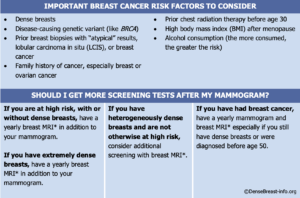
*If you are not able to have a breast MRI, a contrast-enhanced mammogram (CEM) or molecular breast imaging (MBI) may be options. Ultrasound can be considered if these options are not possible. Breast MRI is not recommended after age 74 and decision to have breast MRI between age 70-74 should be based on individual health and preferences.