
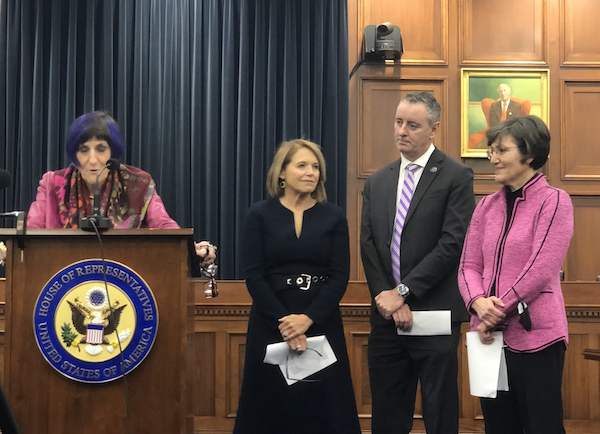
Rep. Rosa DeLauro, journalist Katie Couric, Rep. Brian Fitzpatrick, and
DBI Executive Director JoAnn Pushkin introduce the Find It Early Act in Washington, D.C.
A Federal bill, the Find It Early Act, introduced by Reps. DeLauro (D), Fitzpatrick (R), and Sens. Klobuchar (D), Marshall (R), would ensure all health insurance plans cover screening and diagnostic breast imaging with no out-of-pockets costs for women with dense breasts or at higher risk for breast cancer. It also includes women at increased risk whose health provider recommends additional breast imaging to start before the age of 40 based on factors such as race or ethnicity, personal, or family medical history. DenseBreast-info.org was invited to participate at the press conference on Capitol Hill. This bipartisan legislation would help address insurance barriers to breast cancer screening and lead to the earlier detection of breast cancer in women with dense breasts or at increased risk.
A Statement of Support for the Find It Early Act from 50+ leading organizations, HERE.
How to Support the Find It Early Act
For a bill to move forward into law, support from other congress members and senators is important. Sharing your thoughts with your federal representatives would be helpful for their consideration.
Below are some suggestions on how to do that:
- Who is my congressperson or senator? Use these links to get phone/email contact information for your federal representatives:
Congress: (see zip code search at top right), https://www.house.gov/representatives.
Senate: (click on your state), https://www.senate.gov/states/statesmap.htm
- Let’s meet!
- In person or virtual “visits” are most effective, but phone calls can help, too. Call the representative’s
 district office located near you and request a meeting with the him/her when they will be in their district office or with the relevant staff member who handles “health” issues.
- The goal of the meeting is to explain why you feel the Find It Early Act is important and to ask if your representative will consider co-sponsorship of the bill (co-sponsorship is when a congressperson or senator adds their name as a supporter of an existing bill).
- If you are affiliated with an advocacy group or have friends who would like to attend the meeting, make plans to attend as a group.
- In person or virtual “visits” are most effective, but phone calls can help, too. Call the representative’s
- Be Prepared
- At the meeting, please be ready to share any personal experience(s) with breast imaging and insurance coverage issues (for instance, bring an insurance bill if you feel comfortable, or explain how out-of-pocket costs affected your breast screening), or anything else relevant. It is important to explain why you feel the bill is important.
- This printable/shareable handout might help your talk (or can be sent after the call as follow up): Find It Early Act Fact Sheet
- If your state has an existing state insurance law, your representative will find that of interest (as this federal bill builds on what your state already requires). To learn if your state does, see the Find It Early Act Fact Sheet (above) or this MAP.
- Manners matter! Your representative is busy and has many demands on their time. Do send a thank you note or email after the meeting and certainly acknowledge if they have agreed to cosponsor the bill.
- Am I done? If your representative would like more information or has indicated that they will consider your request, certainly follow up and check in. Contact Us if you have any questions.
To co-sponsor the Find It Early Act, your representative should contact the office of one of the sponsoring legislators.