
• Skip to primary navigation
  • Skip to main content
DB-I Logo

DenseBreast-info, Inc.

Get Smart About Being Dense

HOME/USA

EUROPE

Español

  • Home
  • For Patients
    • Patients Home
    • Dense Breasts: 5 Facts You Should Know
    • Is My Mammogram Enough?
    • Screening Tests After a Mammogram (Table)
    • Let’s Talk About Dense Breasts, Video Series
    • Patient Questions and Answers
    • Patient Resources by Language
    • Print: Patient Fact Sheet
    • Print: Patient Brochure
  • For Providers
    • Providers Home
    • CME/CE: “Dense Breasts, Risk, and Supplemental Screening”
    • Flow Chart: Who Needs More Screening?
    • Health Care Provider FAQs
    • Risk Model Tutorial
    • Table: Mammography Guideline Comparison
    • Table: Dense Breast Screening Guidelines
    • Table: High/Increased-Risk Screening Guidelines
    • DBI Research
    • Patient Resources
  • Screening Technologies
    • Screening Technologies Home
    • For Patients: Screening Tests After a Mammogram (Table)
    • For Providers: Cancer Detection by Screening Method (Table)
    • 2D/3D Mammography
    • Mammography AI Screening Tools, Comparative Tables
    • Breast Ultrasound (Sonogram)
    • Breast MRI
    • Contrast-Enhanced Mammography (CEM)
    • Molecular Breast Imaging
    • DBI Research
  • Inform/Insurance Laws
    • Inform/Insurance Laws Home
    • Inform: Federal FDA Dense Breast Reporting
    • Insurance
      • State Law Insurance Map and Federal HRSA Guidelines
      • State Law Insurance Table
      • Federal Insurance Bill: Find It Early Act
  • Blog & Press
  • About Us
    • About Us Home
    • Our Mission
    • World Dense Breast Day
    • Our Team
    • DBI Research
    • Let’s Talk About Dense Breasts, Video Series
    • Patient Resources
    • Contact Us
    • Please Donate
  • Our Corporate and Health Group Supporters
/ Providers FAQs / What is dense breast tissue? What are dense breasts?

What is dense breast tissue? What are dense breasts?

All breasts contain ducts, glands, fibrous tissue, and fat. Dense tissue is made of glands and fibrous tissue (“fibroglandular” tissue). Dense tissue blocks x-rays and therefore shows up as white on a mammogram. The muscle behind the breast, lymph nodes, and most other breast masses will also absorb x-rays and appear light gray or white on a mammogram, too. Fatty tissue allows more x-rays to penetrate and therefore shows up as black or dark gray on a mammogram. Each woman’s breasts are different than the next and contain a unique mix of fatty and dense tissue. Some women’s breasts are almost all fat, some have very little fat, and some are in between. Some dense breasts are mostly fibrous tissue and some are mostly glandular tissue.  Dense breasts are normal and tend to become less dense with age and menopause. Breast density is not determined by how a breast looks or feels. Density is determined from a mammogram, either by a radiologist or by software.
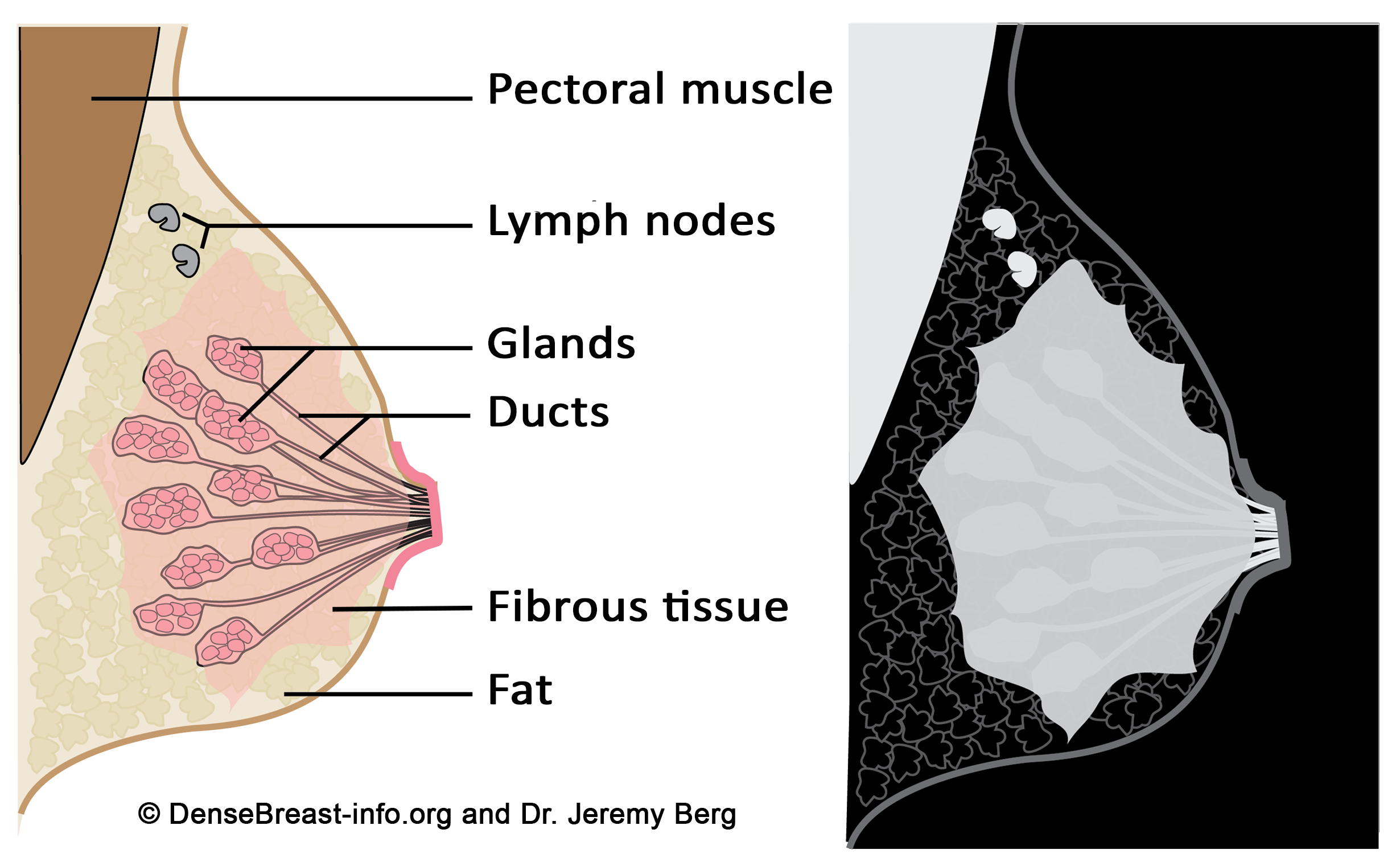
diagram of the normal breast

Figure Diagrams of the normal breast. Left: The normal breast is composed of milk-producing glands at the ends of ducts that lead to the nipple. Varying amounts of fibrous tissue surround the glands. There is layer of fat just beneath the skin. Often a few lymph nodes and the underlying muscle are seen near the underarm (axilla). Right: On a mammogram, fat appears dark gray, glands and fibrous tissue (dense tissue) as well as muscle and lymph nodes appear light gray or white. Masses due to cancer also appear white.

Browse All Provider FAQ's

DenseBreast‑info, Inc. is an independent, nonprofit organization. DBI is not affiliated with or endorsed by other organizations unless expressly identified. If you have questions about DBI’s programs or partnerships, please contact us.

© Unpublished, DenseBreast-info, Inc. ALL RIGHTS RESERVED | 501(c)(3) Public Charity

  • Online Privacy Policy
  • Online Terms of Use & Disclaimers

This website is for informational purposes only and is not intended to be a substitute for medical advice from a physician or to create a standard of care for health care providers. In addition, information has been provided by independent third parties and may not represent the views of DenseBreast-info.org. Please check with a physician regarding your specific condition, if you have any questions, or need a diagnosis. If you are experiencing an urgent medical condition, call your local emergency services [e.g., 9-1-1 (in the USA) or 1-1-2 (in Europe)].