• Skip to primary navigation
  • Skip to main content
DB-I Logo

DenseBreast-info, Inc.

Get Smart About Being Dense

HOME/USA

EUROPE

Español

  • Home
  • For Patients
    • Patients Home
    • Dense Breasts: 5 Facts You Should Know
    • Is My Mammogram Enough?
    • Screening Tests After a Mammogram (Table)
    • Let’s Talk About Dense Breasts, Video Series
    • Patient Questions and Answers
    • Patient Resources by Language
    • Print: Patient Fact Sheet
    • Print: Patient Brochure
  • For Providers
    • Providers Home
    • CME/CE: “Dense Breasts, Risk, and Supplemental Screening”
    • Flow Chart: Who Needs More Screening?
    • Health Care Provider FAQs
    • Risk Model Tutorial
    • Table: Mammography Guideline Comparison
    • Table: Dense Breast Screening Guidelines
    • Table: High/Increased-Risk Screening Guidelines
    • DBI Research
    • Patient Resources
  • Screening Technologies
    • Screening Technologies Home
    • For Patients: Screening Tests After a Mammogram (Table)
    • For Providers: Cancer Detection by Screening Method (Table)
    • 2D/3D Mammography
    • Mammography AI Screening Tools, Comparative Tables
    • Breast Ultrasound (Sonogram)
    • Breast MRI
    • Contrast-Enhanced Mammography (CEM)
    • Molecular Breast Imaging
    • DBI Research
  • Inform/Insurance Laws
    • Inform/Insurance Laws Home
    • Inform: Federal FDA Dense Breast Reporting
    • Insurance
      • State Law Insurance Map and Federal HRSA Guidelines
      • State Law Insurance Table
      • Federal Insurance Bill: Find It Early Act
  • Blog & Press
  • About Us
    • About Us Home
    • Our Mission
    • World Dense Breast Day
    • Our Team
    • DBI Research
    • Let’s Talk About Dense Breasts, Video Series
    • Patient Resources
    • Contact Us
    • Please Donate
  • Our Corporate and Health Group Supporters
/ Blog / Federal Insurance Bill Re-introduced + News Efforts and Materials Abroad
Federal Insurance Bill Re-introduced + News Efforts and Materials Abroad | Dense Breast Info

Federal Insurance Bill Re-introduced + News Efforts and Materials Abroad

November 24, 2025 by JoAnn Pushkin

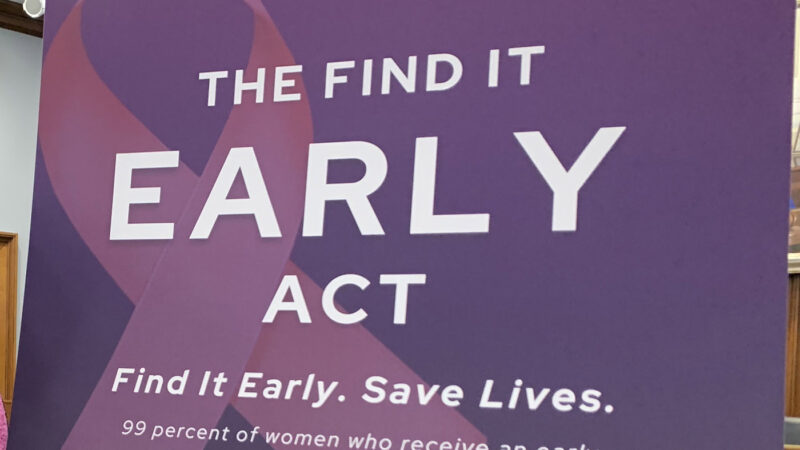
The Find It Early Act

The federal insurance bill, the Find It Early Act, has now been re-introduced in both the House and Senate. DBI has been closely involved in the bill’s development, introduction, and ongoing progress. [Fun fact-the bill’s title was inspired by DBI’s #FindItEarly tagline.] Once the House bill is formally numbered (Senate version is S1410), DBI will again organize a Statement of Support from national medical societies, advocacy groups, and health systems. Stay tuned!


Australia: Breast Density Information for GPs

BreastScreen Australia has introduced Breast Density Measurement, Reporting, and Guidance for Health Professionals to help women understand breast density measurement, reporting and screening considerations and to increase their confidence in the breast screening program. For information about awareness and education efforts in Australia, please visit information forum InforMD.


New Study

In a study using prior negative mammograms from 524 women who developed interval breast cancer in the UK, among a total of 134,217 negative mammograms, Mirai deep learning software could identify women at risk for interval cancer 1-, 2-, or 3-years later.1  Accuracy was not affected by patient age or breast density.  Specifically:

  • The highest 1%, 5%, 10%, and 20% of three-year risk scores predicted 3.6%, 14.5%, 26.1%, and 42.4% of women who developed interval cancer.
  • Of 469 women with interval cancer and breast density information, 285 (60.7%) developed in those with dense breasts, and 37.8% of women had dense breasts.

Use of Mirai software may improve recognition of some women who may benefit from supplemental screening after a negative mammogram distinct from those with dense breasts alone, but only the minority of women who developed interval cancer would have been selected based on the top 20% Mirai risk.  Women with extremely dense breasts had similar risk of interval cancer as those in the top 20% Mirai risk.  It is unclear how the combination of heterogeneously dense breasts plus other risk factors would have performed, as is used in many breast centers in the United States.

1 The area under the receiver operating curve (AUC) was 0.72, 0.67, and 0.67 for years 1, 2, and 3, respectively (P ≥ .63).

DenseBreast‑info, Inc. is an independent, nonprofit organization. DBI is not affiliated with or endorsed by other organizations unless expressly identified. If you have questions about DBI’s programs or partnerships, please contact us.

© Unpublished, DenseBreast-info, Inc. ALL RIGHTS RESERVED | 501(c)(3) Public Charity

  • Online Privacy Policy
  • Online Terms of Use & Disclaimers

This website is for informational purposes only and is not intended to be a substitute for medical advice from a physician or to create a standard of care for health care providers. In addition, information has been provided by independent third parties and may not represent the views of DenseBreast-info.org. Please check with a physician regarding your specific condition, if you have any questions, or need a diagnosis. If you are experiencing an urgent medical condition, call your local emergency services [e.g., 9-1-1 (in the USA) or 1-1-2 (in Europe)].