
New NCCN Guidelines Add 5-Year Risk to Breast Screening: What It Means for Your Patients
NCCN Update: Incorporating 5-Year Risk
The March 2026 NCCN breast screening guidelines now include guidance to “consider” supplemental MRI screening for women with a 5-year Gail model risk ≥1.7%, in addition to the recommendation for MRI using a ≥20–25% lifetime risk threshold.
These approaches differ in important ways:
- 5-year risk increases with age, with most women over age ~58 exceeding the ≥1.7% threshold.
- Lifetime risk decreases with age, with ~20% of women in their 40s qualifying vs. ~1% in their early 70s.
- The Gail model does not include breast density, which affects both masking risk and risk of developing breast cancer.
- Note that other risk models such as Tyrer-Cuzick/ IBIS v8, and BOADICEA (CanRisk) include breast density as a risk for developing breast cancer for women 40 years and older and the BCSC risk model includes breast density for women ages 35 -74 years. None of the existing models explicitly consider the masking risk of dense breast tissue.
- Screening MRI is generally not recommended beyond age 74 even in the healthiest high-risk women, because it would not be cost effective.
New Data: Aligning Risk Thresholds
Colditz et al. (Journal of Breast Imaging) provide estimates based on USA SEER data aligning 5-year and lifetime risk:
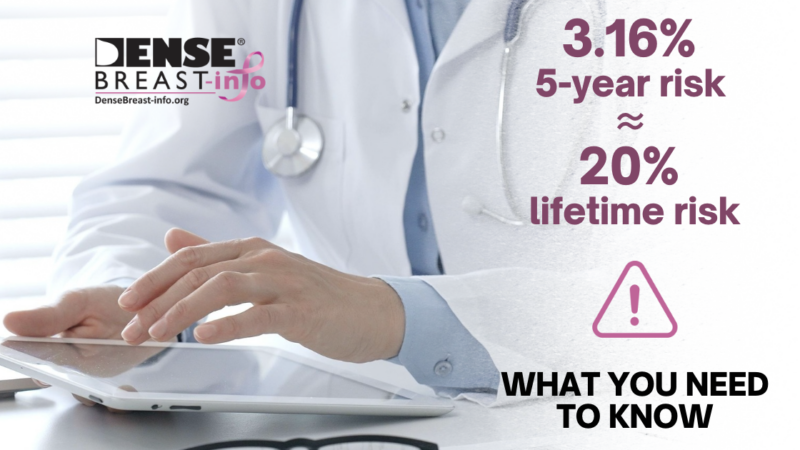
- 3.16% 5-year risk ≈ 20% lifetime risk, on average
- The United States Preventive Services Task Force defines 3% 5-year risk as “high risk”
Age-specific 5-year Gail risk equivalents to 20% lifetime risk:
- 40–44: 1.34% | 45–49: 2.05%
- 50–54: 2.64% | 55–59: 3.3%
- 60-64: 4.65% | 65-69: 6.93%
- 70-74: 10.85%
The NCCN also notes that image-based risk assessment, i.e. AI tools that review mammograms, may complement or replace clinical models. Such tools provide consistent outputs that incorporate breast density.
Implications for Screening
Ideally, supplemental screening recommendations would consider both the risk of missed cancers on mammography and the risk of developing breast cancer. Screening MRI is recommended for women with extremely dense breasts and for those with ≥20–25% lifetime risk regardless of breast density. For women with heterogeneously dense breasts, MRI may be “considered” (per the new NCCN guidelines and ACR), but especially if there are additional risk factors (e.g., family history, atypia, elevated 5-year risk) that result in ≥20% lifetime risk. Adding a 5-year risk threshold adds a short-term perspective, but low cutoffs (e.g., ≥1.7%) will unnecessarily identify many women as candidates for MRI based on older age alone (including women with fatty breasts); higher 5-year risk thresholds (~3% for women under age 60 and even higher for older women) more closely align with the established lifetime risk criteria. For younger women, lifetime risk is more appropriate to guide supplemental screening. Optimal risk and age thresholds for annual vs. biennial supplemental screening MRI are not yet standardized and continue to evolve.
Insurance and Access
Insurance may or may not cover screening MRI based on a report stating “consider” MRI, but typically will cover a “recommended” screening MRI – though Medicare and VHA/TRICARE coverage is not required. Further, there are already substantial access issues for screening MRI: population-based screening MRI in all older women would greatly reduce access for women at high risk and/or high risk for missed cancer on mammography.