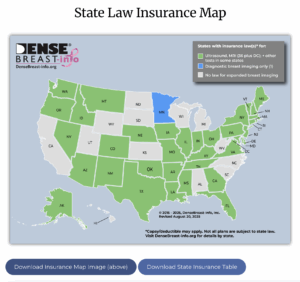
DBI’s insurance map detailing state laws for expanded breast imaging coverage based on our legislative analysis has been updated. Please click HERE (download option beneath the image). As a reminder coverage varies by state, please click on individual state links for specific information by state.
Blog
UPDATED Screening Decision Support Tool
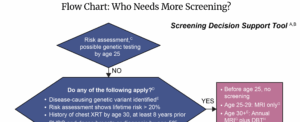
Screening Decision Support Flowchart
Our very popular screening decision support tool Who Needs More Screening? has just been updated. The flowchart details evidence-based screening recommendations designed to optimize cancer detection in individuals in different risk categories, including dense breasts.
World Dense Breast Day 2025
Proud Founder and Official Sponsor of World Dense Breast Day
A reminder that World Dense Breast Day will be on September 24th this year. The purpose of this worldwide one-day social media blitz is to raise awareness about dense breasts and share medically-sourced educational resources available for women and health providers. Visit this page to learn how to participate. In 2024, over 16.8 million people saw/read #WorldDenseBreastDay social media posts from 104 countries! Please mark your calendars and keep an eye out for upcoming details and materials.
FDA Updated “Density” Reporting Language
To allow interpreting physicians to provide an overall assessment of breast density that is phrased in the singular, or phrasing that is neither singular nor plural, an FDA alternative standard has been approved, effective immediately, for all facilities subject to MQSA. The singular phrasing is intended to be used in reports to referring providers (not the patient notification) of unilateral mammograms. For more info, visit DBI page FDA National Reporting Standard (see “Report to Referring Providers” section).
NCCN Foundation Patient Resources; Newly Published Pre-screening Survey
National Comprehensive Cancer Network (NCCN) Foundation
The NCCN Foundation’s 2025 patient resource Breast Cancer Screening and Diagnosis is hot off the presses! DBI was honored to be invited to qualify as an included resource. The NCCN Foundation has additional free patient resources which can be found HERE.
Just Published
Recently published in the Journal of Breast Imaging, DenseBreast-info.org Medical Advisory Board member Dr. Linda Larsen and colleagues report on a pre-screening survey completed by 6833 women with prior mammography and dense breasts undergoing mammography and screening ultrasound tomography at 9 imaging facilities across 8 states. Overall, 4930 (72.1%) women were aware of their breast density. Factors that increased knowledge of breast density included:
- Breast density notification law1
- Women not of Hispanic or Latina ethnicity2
- Some college education or above3
- Personal history of breast cancer4
Knowledge of breast density also increased anxiety.
While the FDA’s Sept 2024 requirement for standardized density “inform” notification is now in effect and should improve awareness, there is still a need for patient educational materials in other languages. See DBI’s Patient Resource by Languages.
1 2837/3698 (76.7%) women with a breast density notification law (BDNL) in effect at the time were aware of breast density compared to 2091/3170 (66.0%) without a BDNL (P<.001).
2 618/1055 (58.6%) of Hispanic/Latina women were aware vs. 4287/5785 (74.1%) of non-Hispanic or Latina women (P<.001).
3 Adjusted odds ratio was 2.70 (95%CI 2.36, 3.08) compared to women with only high-school education.
4 Adjusted odds ratio was 2.03 (95%CI 1.35, 3.05) compared to those without a prior history of breast cancer.
Updates to Dense Breast Screening Guidelines and Risk Model Table
Risk/Screening Tables
Our new and very popular High/Increased Risk, Dense Breast Screening Guidelines content has been updated to reflect the latest guidelines from the National Comprehensive Care Network (NCCN) for women with dense breasts and no other risk factors (see Table 2 on the page).
Risk Model Table with Links
The helpful Risk Models table (with live inks) within DBI’s “Risk Model Tutorial” has also been updated, see HERE (Section 4).
UK News: Daily Mail on DBI Breast Density Insights
UK News
The Daily Mail newspaper ran a comprehensive piece about the need for breast density “inform” in the UK, “Patients have a right to know. Too many have died” (subscription required). Two DBI team members were interviewed for their insights and input:
- Chief Scientific Advisor, Dr. Wendie Berg, “Just knowing is pertinent to taking care of yourself… the denser your breasts are, the more you want to be aware of changes in your breasts and not ignore them”.
- European Education Coordinator, Cheryl Cruwys, “I know of too many women who are no longer with us because they weren’t told they had dense breasts and as a result their cancer wasn’t spotted until too late.”
Canadian Guidelines; New CEM Study, DBI in the News
Canadian Breast Screening Guidelines
News from Dense Breasts Canada, “For the past 8 years, DBC has consistently pushed for action on outdated and baised guidelines that limit access to lifesaving screenings and fail to incorporate expert input and the latest scientific evidence.” Change is now coming: Minister Michel welcomes External Expert Review report on the modernization of preventive health care guideline development in Canada
New Study
In a study funded by the Pennsylvania Breast Cancer Coalition, DenseBreast-info.org’s Chief Scientific Advisor Dr. Wendie Berg and colleagues report results on screening contrast-enhanced mammography (CEM) combined with 3D mammography in 601 women at higher risk for breast cancer. All examinations were reviewed by two radiologists and all women had either cancer diagnosis or one-year follow-up.
- CEM doubled cancer detection.¹
- Cancers found by CEM were small and node negative.²
- False-positive recalls increased with addition of CEM.³
¹There were 12 women with cancer identified, with 6 of these identified on standard 3D mammograms (with one of these seen only by a second radiologist review), and 6 seen only on CEM (incremental cancer detection rate 10.0/1000, 95%CI 3.3, 18.3).
²Of the 6 cancers found only on CEM, 5 were invasive (including 3 lobular type), all node negative, with median size 0.7 cm.
³Of 589 women without breast cancer, 48 (8.1%) were recalled for additional testing based on standard 3D mammography. After combined CEM+3D, 127 (21.6%) were recalled, an absolute increase of 79/589 (13.4%).
For a video detailing more information about dense breasts and CEM at UPMC, including one of the participants in the study, see https://youtu.be/x2JXWti9sUI.
Read more about the study in AuntMinnie, CEM improves cancer detection when added to screening DBT exams
DBI in the News:
DenseBreast-info is the “go-to” resource for patients, providers, legislators, and the media. We have recently been asked for comment by several national outlets:
- New York Times: One Type of Mammogram Proves Better for Women With Dense Breasts
- Aunt Minnie: BRAID study shows promise for imaging dense breasts; experts sound off
- WebMD: Dense breast tissue can hide cancer: now what?
- SiriusXM Doctor Radio, listen to Dr Berg discuss dense breasts, supplemental screening and insurance issues, and provide more detailed info on CEM.
New State Insurance Bill, UK/BRAID Lecture
U.S. State Insurance Bill
Pennsylvania has introduced insurance bill S88 which would eliminate cost sharing for diagnostic breast imaging and supplemental screening MRI, and for ultrasound when indicated. For details on existing state insurance laws, please visit HERE.
UK News
Dense breast online lecture: Dr Fiona Gilbert, consultant radiologist at Cambridge University Hospital, led the groundbreaking BRAID study involving over 9,000 women, 85 of whom were diagnosed with early-stage breast cancer. In this lecture, “Breast cancer screening and what to know about dense breasts,” Dr Gllbert will discuss what it means to have dense breasts, the results of the trial, and how breast cancer risk can be reduced.
Details: Monday 7 July, 2025, 6:30–7:30pm (BST – British Summer Time). For information and registration: Microsoft Virtual Events Powered by Teams
New state insurance laws, Welcome to a new BOD member
New State Insurance Laws
Two existing laws have been amended to clarify/expand coverage:
- Colorado – Amendment expands and clarifies coverage for breast cancer screenings and that diagnostic and supplemental breast examinations do not require cost sharing by the patient.
- Oklahoma – Though originally vetoed by the governor, the veto has been overridden, and the bill has become law. Among other changes, the new law covers supplemental screening with no cost sharing by the patient.
For more information by state, visit: State Law Insurance Map or State Law Insurance Table
New Board of Director Member
We welcome Deepa Narayanan to DBI’s BOD! Deepa is the Chief of Staff for Operations at the Advanced Research Projects Agency for Health (ARPA-H), a new federal agency dedicated to accelerating innovation in healthcare. She brings over a decade of experience in strategy, operations, and program management across federal, industry, and startup sectors.
Prior to ARPA-H, Deepa was at Amazon Web Services (AWS), where she supported healthcare and life sciences startups worldwide, helping them scale operations and connect with both internal AWS experts and external investors. Before AWS, she spent over a decade at the National Cancer Institute (NCI), where she supported hundreds of oncology startups—particularly in breast cancer—by providing early-stage funding and commercialization resources to accelerate their growth. Deepa is a Certified Clinical Data Manager. She holds a Master’s degree in Biomedical Engineering from the University of Virginia and an MBA from the University of Illinois Urbana-Champaign.
New state insurance law, Australia INFORM, Study on parenchymal texture and risk
New State Insurance Law
Florida is the latest state to expand insurance coverage requirements for breast imaging. NOTE: this limited law applies only to Florida state employee health contracts or plans. For details, visit DBI’s legislative resources:
Australia INFORM!
Breaking news from research scientist and founder of InforMD Wendy Ingman, “In a landmark policy change, BreastScreen Australia now recommends that breast density be reported to women as part of routine mammography screening.” Find the Position Statement HERE. Congratulations to the advocates who have fought for this for nearly a decade!
New Study
Winham et al report on development and validation of mammographic parenchymal textural features that predict increased risk for breast cancer and also predict masking risk/ increased risk of interval cancer. They analyzed full-field digital screening mammograms from over 29,000 women at multiple centers and identified six breast parenchymal feature/texture types. The extracted types were then applied to a separate nested case-control cohort that included mammograms on over 1000 women with cancer.
- The feature/texture types were significantly associated with both risk of developing cancer¹ and risk of masking².
- These texture types did not distinguish higher or lower risk among women with dense breasts.
- One texture type distinguished lower risk among women with non-dense breasts³.
- The authors conclude that parenchymal textural features have potential to improve risk prediction and personalized screening strategies for women with high or low breast cancer risk.
The magnitudes of risk in this study were generally less than those associated with breast density, though this may help identify women at lower risk among those with non-dense breasts. Other studies have shown that textural features complement density in risk assessment and adding textural features to AI models of risk does appear to improve performance.
¹The highest risk types had odds ratio (OR) of 1.17 (95%CI 1.08, 1.27) and 1.12 (95%CI 1.03, 1.21) and the lowest 0.87 (95%CI 0.78, 0.96). The greatest impact on identifying a subset of women with reduced risk was observed in Black women.
² The highest masking risk types had OR of 1.60 (95%Ci 1.24, 2.07) for false negative findings and 1.65 (95%CI 1.21, 2.26) for symptomatic interval cancer, and the lowest 0.63 (95%CI 0.45, 0.88) for false negatives and 0.63 (95%CI 0.42, 0.94) for interval cancer.
³ Odds ratio for breast cancer risk was 0.78 (95%CI 0.68, 0.89) for one texture type in non-dense breasts.
New state insurance bills, UK BRAID trial published
State Insurance Bills
Newly introduced state insurance bills to cover expanded breast imaging include the following:
European News: Just Published
Prevalence supplemental screening results from the randomized UK BRAID trial were published 5/21/2025 in The Lancet. More than 9300 women with dense breasts and negative 2D mammogram aged 50-70 years were randomized to one of four screening groups (over 2000 women in each group): supplemental screening with abbreviated MRI (AB-MRI), automated whole breast ultrasound (ABUS), contrast-enhanced mammography (CEM), or standard of care (no supplemental screening).
Finding: Supplemental screening in women with dense breasts results in earlier detection, with AB-MRI and CEM finding more cancers than ABUS with higher recall rates.
- Cancer detection rates were higher for AB-MRI and CEM than for ABUS, but all modalities significantly increased cancer detection.1
- Recall rates were higher for AB-MRI and CEM than for ABUS.2
- Among those women invited to supplemental screening, participation rates were highest among women invited to have ABUS.3
- All cancers detected were small, but cancers seen with contrast methods were smaller.3
- All cancers detected by ABUS were invasive, as were 82% and 86% detected by CEM and AB-MRI, respectively.3
- Just over 1% of women having CEM experienced a contrast reaction.4
Note: Added cancer detection rates in this study were higher than most prior reports for AB-MRI, ABUS, or CEM, likely because of longer interval between the initial mammogram and the supplemental screening (median 3-4 months, but up to one year). Added yields are expected to be somewhat lower after tomosynthesis and in incidence screening. Normal cases were offered a second round of screening at 18 months; interval cancer rates are not yet known as there has not been sufficient follow-up.
1 Added cancer detection rates for AB-MRI, ABUS, and CEM were 17.4/1000, 4.2/1000, and 19.2/1000, respectively. Cancer detection rates were significantly higher for AB-MRI and CEM than for ABUS. A control group at Cambridge having only digital mammography had a cancer detection rate of 8.4/1000: supplemental contrast-enhanced screening more than doubled cancer detection.
2 Recall rates were 9.7%, 4.0%, and 9.7%, for AB-MRI, ABUS, and CEM, respectively.
3 Approximately 95.5% of invited women completed ABUS vs. 91.8% AB-MRI and 91.1% CEM.
3 Median invasive cancer size for AB-MRI, ABUS, and CEM respectively was 10 mm (IQR: 8-15 mm), 22 mm (IQR: 14 – 35 mm) and 11 mm (7 – 15 mm). Invasive-only added cancer detection rates were: 15.0/1000, 4.2/1000, and 15.7/1000 for AB-MRI, ABUS, and CEM respectively.
4 Among 2035 women having CEM, 17 had minor contrast reactions (8.4 per 1000); 6 had moderate (2.9 per 1000) and 1 severe (0.5/1000). There were no contrast reactions with MRI. Another 3 women had contrast extravasation with CEM as did one (of 2130) with MRI).
U.S. State and Federal Insurance Legislation, New Ultrasound Study
State Insurance Bills
Two new state insurance bills for expanded breast imaging coverage have been introduced:
Find It Early Act
As the 2025 Congressional session has begun, re-introduction of the federal Find it Early Act is scheduled. The Senate version has already been formally re-introduced (S1410), and the House bill re-introduction will follow soon.
New Study
Niu et al report on the effectiveness of primary screening with breast ultrasound among women in low-resource settings in rural China. 9100 women ages 35-64 underwent hand-held US (HHUS) and automated breast ultrasound (ABUS). Women over age 45 were also screened by mammography (MG). All modalities were statistically equivalent but ABUS alone performed very well.
- The overall CDR was 2.7/1000 women screened and there were no statistical differences in sensitivity and specificity among the 3 screening methods, although the CDR of ABUS was greater than HHUS or MG.¹
- ABUS detected 2 cancers missed by HHUS and MG, and, in women with dense breasts, ABUS had the highest diagnostic performance of the 3 screening methods.²
- ABUS overall accuracy in women with non-dense breasts was comparable to HHUS and mammography.³
- The proportion of women with dense breasts among women aged 45-64 was 67.5%.
¹ There were 25 cancers among 9100 women screened, with CDR of 3.0 for ABUS, 2.3 for HHUS and 2.0 for MG per 1000 women screened.
² Note: BI-RADS 3 was considered “negative” in this analysis, but typically represents a “positive” screening test; 9.9% of ABUS examinations were assessed as BI-RADS 3 in women with dense breasts (as were 12.6% of HHUS and 13.1% of MG examinations). Among women with dense breasts, ABUS sensitivity was 81.8%, specificity (with BI-RADS 3 considered negative) was 98.5%, PPV3 16.7%, NPV 99.9%, and AUC 0.902. Sensitivity of HHUS was 63.6% and of MG 54.6%, but differences were not significant.
³ Among women with non-dense breasts, sensitivity of all three modalities was 100%. ABUS specificity was 99.5%, PPV3 41.7%, NPV nearly 100% and AUC 0.998.
World Dense Breast Day
Please mark your calendars! #WorldDenseBreastDay will be celebrated on September 24th. This 24-hour education marathon is sponsored by DenseBreast-info and has been added to the National Day Calendar. Last year’s successful event involved participants from 104 countries and over 16.8 million people saw/read the social media posts. News: This year we look forward to the participation and reach of the World Health Organization! Details to follow, learn more about the day HERE.
Legislation Update, New Study U.S. State Insurance Legislation Update
U.S. State Insurance Legislation Update
- New Law: Arkansas has amended its existing insurance law to include supplemental screening modalities, CEM, MRI, US and MBI and to eliminate cost sharing on diagnostic examinations. For more details, please visit the DBI Legislation Map.
- New Bill: Colorado has introduced a new insurance bill for expanded breast imaging coverage, SB296.
New Study
In a single-center analysis from the United Kingdom, Payne et al reported results on 49,948 digital screening mammograms showing that increasing Volpara-based assessed breast density adversely affects screening mammography performance. They verified that the current quantitative Volpara threshold between category B, scattered fibroglandular density and C, heterogeneously dense, is appropriate, with worse performance in dense breasts. Overall, 205/614 (33.4%) of cancers were symptomatically detected.
- Symptomatic interval cancer rates increased with each density category.1
- Sensitivity decreased with each density category.2
- Recall rates were higher in dense breasts.3
- Cancer rates increased with increasing breast density.4
The authors suggest consideration of supplemental screening in women with extremely dense breasts and stress that the 3-year screening interval contributes to delayed diagnosis. Currently, most women in the UK are not informed of their breast density, and supplemental screening is not widely available.
1 Interval cancer rates at 3 year follow-up were: 1.8/1000 for category A, fatty breasts; 3.2/1000 for category B, scattered fibroglandular density; 5.7/1000 for category C, heterogeneously dense; and 7.9/1000 for extremely dense breasts.
2 Sensitivity was: 75% in category A, fatty breasts; 73.5% in category B, scattered fibroglandular density; 59.8% in category C, heterogeneously dense breasts; and 51.3% in category D, extremely dense breasts (significantly worse in category C or D compared to B).
3 Recall rates were: 3% for category A; 4.5% for category B; 5.5% for category C; and 5.3% for category D.
4 Total cancer rates (screen-detected plus interval cancers) were: 7.4/1000 for category A; 12.2/1000 for category B; 14.2/1000 for category C; and 16.1/1000 for category D.
SBI Keynote and Honorees, New Study
Society of Breast Imaging (SBI)
The Society of Breast Imaging’s 40th annual symposium begins next week! Join Keynote Speaker, DBI’s JoAnn Pushkin, MAB member Dr. Paula Gordon, MAB past member Dr. Georgia Spear and others, for the Keynote Advocacy Session: The Changes We Fought for and the Patients Who Benefitted (April 24th at 11:10am).
SBI Honorees
Congratulations to SBI 2025 Gold Medalist Dr. Paula Gordon and to 2025 SBI Honorary Fellow JoAnn Pushkin.
New Study
Caumo et al reported on the first screen results in the Italian Risk-Based Breast Screening study (RIBBS) which personalizes screening based on risk and breast density. Women age 45 with high Volpara volumetric breast density > 25% were invited for screening tomosynthesis (DBT) plus supplemental ultrasound (US). Women with a high lifetime breast cancer risk (>30% by Tyrer-Cuzick model) were recommended for supplemental screening MRI instead of US regardless of breast density. This study group was compared to a control group receiving 2D-digital mammography.
- The use of DBT plus US in high-density women was associated with a decrease in recalls and an increase in biopsies.1
- Detection of small invasive breast cancers doubled in the group of women invited to additional screening and was associated with increased detection of DCIS and grade 3 invasive cancers.2
- Regardless of density, low risk women were recommended for biennial screening, while intermediate- and high-risk women were recommended for annual screening.
- The stratification criteria effectively identified subpopulations with different breast cancer prevalence who may benefit from different screening protocols.3
1 Among 10,269 women enrolled in the prospective study, recall rates decreased by 50% while biopsy rates increased 80% in high-density subgroups receiving DBT plus US compared to the control group having only DBT.
2 There was 2.3-fold higher detection of invasive cancers between 1.1 and 2 cm in the intervention group and 2.4-fold higher grade 3 invasive cancer rates, both P<.05. The intermediate-risk group (lifetime risk > 17% and ≤ 30%) with increased breast density showed a 4.6-fold higher prevalence of breast cancer compared to those with low risk and low density.
3 Interval cancer rates have not yet been determined due to insufficient follow-up.