
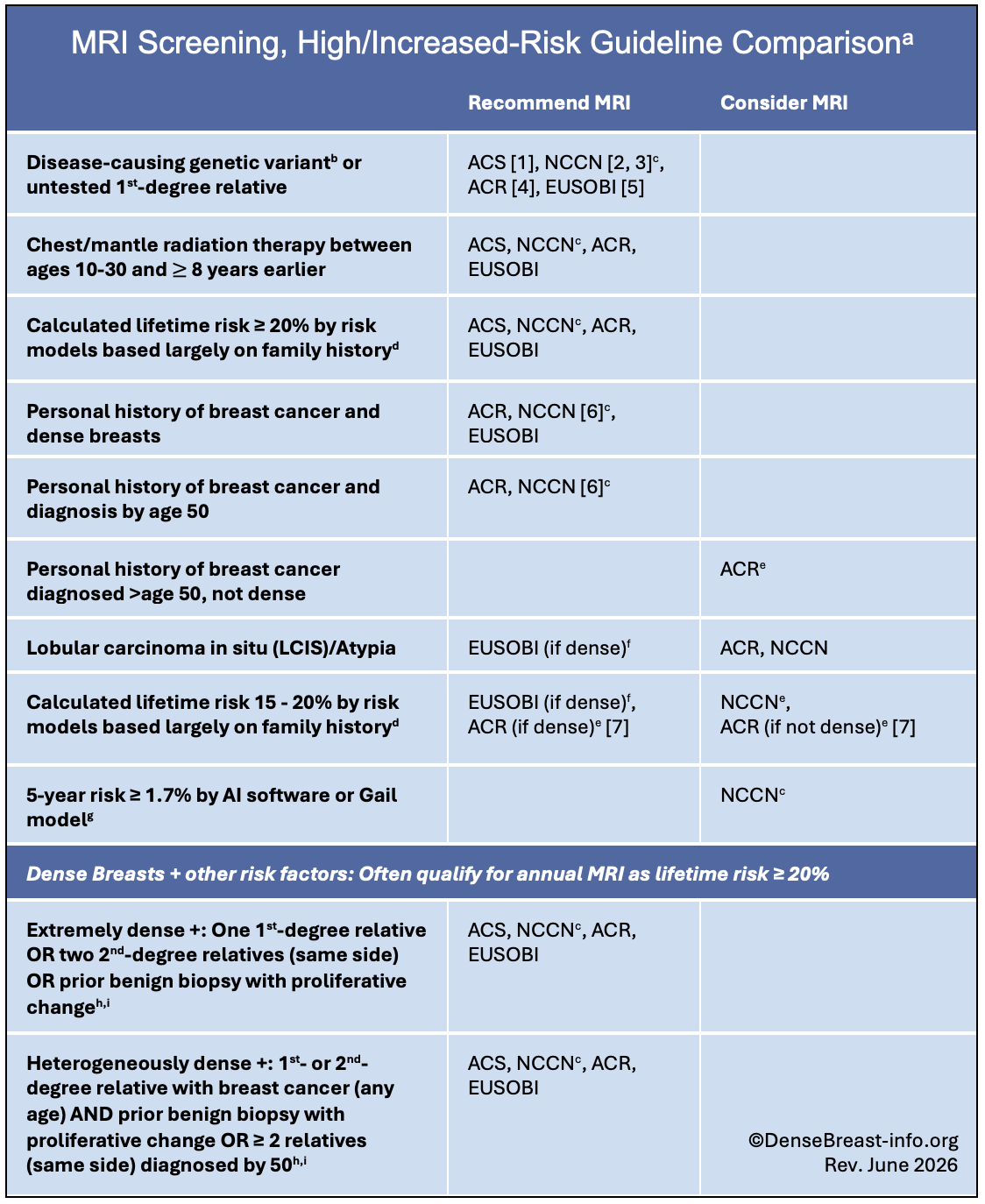
High or increased risk criteria for purposes of recommending MRI screening differ by organization and are provided in the table below. For screening guidelines for women with dense breasts and no other identifiable risk factors, see Dense Breast Screening Guidelines.
Abbreviations used: ACR American College of Radiology; ACS American Cancer Society; NCCN National Comprehensive Cancer Network; EUSOBI European Society of Breast Imaging
a Frequency of MRI screening is annual unless otherwise specified.
b For specific recommendations for age to start and stop screening MRI and include mammography, see https://densebreast-info.org/providers-faqs/what-is-the-screening-management-for-various-other-mutation-carriers/.
c For individuals at high risk who are not able to undergo MRI, supplemental screening with CEM or MBI should be considered. Whole breast ultrasound may be done if contrast-enhanced imaging or functional imaging is not available.
d For more about risk models, see https://densebreast-info.org/for-providers/risk-model-tutorial/.
e Frequency of MRI screening is not specified.
f EUSOBI recommends MRI in women with extremely dense breasts from ages 50-70 at least every 4 years (preferably every 2-3 years). Frequency is not specified for women with heterogeneously dense breasts.
g 5-year risk increases with increasing patient age and, on average, 3.1% 5-year risk is approximately similar to a 20% lifetime risk [8]. Nearly all women have a 5-year Gail model risk of > 1.7% over the age of 58, regardless of breast density, and such a threshold is therefore its use to guide MRI screening is deemed inappropriate by the DenseBreast-info.org medical advisory board.
h Lifetime risk ≥ 20% when entered into Tyrer-Cuzick risk model at https://magview.com/ibis-risk-calculator/ with otherwise average risk factors.
i Proliferative change would be listed in the pathology report from the breast biopsy as any of the following: usual ductal hyperplasia, papilloma, adenosis or sclerosing adenosis, radial scar.
For evidence-based screening recommendations in any risk category designed to optimize cancer detection, see our Screening Decision Support Tool. It details:
- The American College of Radiology (ACR[4]) recommends all women, but especially Black women and women of Ashkenazi Jewish descent, undergo risk assessment and possible genetic testing by age 25.
- Those at higher risk can begin earlier and more aggressive breast cancer screening, as early as age 25.
- All women should start screening at least by age 40.
- Supplemental screening beyond mammography is not generally recommended beyond age 75. At that time, decisions about appropriate screening should be made on an individual basis depending on a woman’s overall health and risk factors.
Considerations
- If MRI screening is recommended but is not available or possible, contrast-enhanced mammography (CEM) [3, 4] or molecular breast imaging (MBI) should be considered [3]. When no contrast-enhanced methods are available, screening ultrasound can be considered [3, 4].
- Per ACR, MBI is “usually not appropriate” for screening due to whole body radiation exposure [4, 7].
- CEM is currently only FDA-approved for diagnostic breast imaging in the United States and has limited availability.
- Any screening test can identify abnormalities that require additional testing for findings that are not cancer (false alarms, or “false positives”). False positives are most common the first time a test is used and decrease when prior comparison examinations are available.