• Skip to primary navigation
  • Skip to main content
DB-I Logo

DenseBreast-info, Inc.

Get Smart About Being Dense

HOME/USA

EUROPE

Español

  • Home
  • For Patients
    • Patients Home
    • Dense Breasts: 5 Facts You Should Know
    • Is My Mammogram Enough?
    • Screening Tests After a Mammogram (Table)
    • Let’s Talk About Dense Breasts, Video Series
    • Patient Questions and Answers
    • Patient Resources by Language
    • Print: Patient Fact Sheet
    • Print: Patient Brochure
  • For Providers
    • Providers Home
    • CME/CE: “Dense Breasts, Risk, and Supplemental Screening”
    • Flow Chart: Who Needs More Screening?
    • Health Care Provider FAQs
    • Risk Model Tutorial
    • Table: Mammography Guideline Comparison
    • Table: Dense Breast Screening Guidelines
    • Table: High/Increased-Risk Screening Guidelines
    • DBI Research
    • Patient Resources
  • Screening Technologies
    • Screening Technologies Home
    • For Patients: Screening Tests After a Mammogram (Table)
    • For Providers: Cancer Detection by Screening Method (Table)
    • 2D/3D Mammography
    • Mammography AI Screening Tools, Comparative Tables
    • Breast Ultrasound (Sonogram)
    • Breast MRI
    • Contrast-Enhanced Mammography (CEM)
    • Molecular Breast Imaging
    • DBI Research
  • Inform/Insurance Laws
    • Inform/Insurance Laws Home
    • Inform: Federal FDA Dense Breast Reporting
    • Insurance
      • State Law Insurance Map and Federal HRSA Guidelines
      • State Law Insurance Table
      • Federal Insurance Bill: Find It Early Act
  • Blog & Press
  • About Us
    • About Us Home
    • Our Mission
    • World Dense Breast Day
    • Our Team
    • DBI Research
    • Let’s Talk About Dense Breasts, Video Series
    • Patient Resources
    • Contact Us
    • Please Donate
  • Our Corporate and Health Group Supporters
  • Home/Europe
  • European Patients
    • Patients Home
    • Dense Breasts: 5 Facts You Should Know
    • Is My Mammogram Enough?
    • Screening Tests After a Mammogram (Table)
    • Let’s Talk About Dense Breasts, Video Series
    • Europe Patient Questions and Answers
    • Patient Resources by Language
  • European Providers
    • Providers Home
    • CME/CE: “Dense Breasts, Risk, and Supplemental Screening”
    • Density Primer
    • Screening Flow Chart
    • Table: Dense Breast Screening Guidelines
    • Table: High/Increased-Risk, Dense Breast Screening Guidelines
    • Health Care Provider FAQs
    • Risk Model Tutorial
    • DBI Research
    • Article: Density Implications/Screening
    • Article: Education/Access to Screening
  • Screening Technologies
    • Screening Technologies Home
    • For Patients: Screening Tests After a Mammogram (Table)
    • For Providers: Cancer Detection by Screening Method (Table)
    • 2D/3D Mammography
    • Mammography AI Screening Tools, Comparative Tables
    • Breast Ultrasound (Sonogram)
    • Breast MRI
    • Contrast-Enhanced Mammography (CEM)
    • Molecular Breast Imaging
    • DBI Research
  • Country/Screening Guidelines
    • Screening Guidelines Home
    • Map: Screening Guidelines by Country
    • Table: Country Comparative Analysis
  • Blog & Press
  • About Us
    • About Us Home
    • Our Mission
    • Our Team
    • World Dense Breast Day
    • DBI Research
    • Our Corporate and Health Group Supporters
    • Let’s Talk About Dense Breasts, Video Series
    • Patient Resources by Language
    • Contact Us
    • Please Donate
  • European Educators
/ Welcome to DenseBreast-info/Europe / European Patients / Is My Mammogram Enough?

Is My Mammogram Enough?

I have dense breasts…now what?
cartoon illustration of 5 women with question marks

Know

  • Dense breasts can hide cancers on a mammogram and also increase the risk of breast cancer.
  • Almost half of women have dense breasts. Learn about five important facts to know.
  • If you have dense breasts, find out whether they are “heterogeneously dense” or “extremely dense.” Check your patient portal, or ask your mammography center or healthcare professional. 

Do

  • If available, get a 3D mammogram (also called digital breast tomosynthesis) instead of a 2D mammogram.
  • Find out your personal risk of breast cancer. Use a free risk-assessment tool, such as the IBIS Risk Calculator. If your lifetime risk of breast cancer is 20% or greater, you are “high risk.”
  • Talk to your healthcare professional about additional screening tests based on your age, breast density, and personal risk (see table below).

Ask Your Health Professional

  • For a prescription, if you want to have additional screening tests such as breast MRI after a mammogram. (Check with your insurance plan to learn if/how much they will cover.) 
  • Whether your breast density and other risk factors mean you should be seen in a high-risk screening program or consider genetic testing. 
  • What breast symptoms or changes should cause you to call before your next mammogram.

Print / Download
Your Guide to Ask for Additional Screening Tests

Risk Factors and Additional Screening Tests
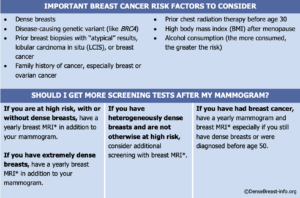
*If you are not able to have a breast MRI, a contrast-enhanced mammogram (CEM) or molecular breast imaging (MBI) may be options. Ultrasound can be considered if these options are not possible. Breast MRI is not recommended after age 74 and decision to have breast MRI between age 70-74 should be based on individual health and preferences.

Screening Tests After Mammogram

DenseBreast‑info, Inc. is an independent, nonprofit organization. DBI is not affiliated with or endorsed by other organizations unless expressly identified. If you have questions about DBI’s programs or partnerships, please contact us.

© Unpublished, DenseBreast-info, Inc. ALL RIGHTS RESERVED | 501(c)(3) Public Charity

  • Online Privacy Policy
  • Online Terms of Use & Disclaimers

This website is for informational purposes only and is not intended to be a substitute for medical advice from a physician or to create a standard of care for health care providers. In addition, information has been provided by independent third parties and may not represent the views of DenseBreast-info.org. Please check with a physician regarding your specific condition, if you have any questions, or need a diagnosis. If you are experiencing an urgent medical condition, call your local emergency services [e.g., 9-1-1 (in the USA) or 1-1-2 (in Europe)].